
INSTITUTIONAL PROFILE
Center for Research on Environment
Health and Population Activities (CREHPA)
Ekantakuna, Jawalakhel, P.O. Box: 9626, Kathmandu, Nepal
Phone: 977-1-5530344, Fax: 977-1-5530341 E-mail: crehpa@crehpa.wlink.com.np
Introduction

Crown Princess visiting CREHPA stall on Population
Day |
Established in July 1994, CREHPA is a
private, not-for-profit research organization registered
under Society’s Act 2034. Also registered with
the Social Welfare Council, Nepal.
CREHPA offers services in three collateral
areas: Consultancy Research, Policy Research and Training
and Action Research.
Objective
To undertake policy relevant research
and use the research results for influencing program
and policy decisions through dissemination, advocacy
and empowerment
Mission
Contribute towards improving health particularly
sexual and reproductive health of the population through
research and training and create enabling environment
for the Nepalese society to enjoy healthy sexual and
reproductive life with dignity through advocacy and
action programs.
Area of Research Expertise
• Population, Family
Planning and Emergency Contraception •
Sexual and Reproductive Health • Male
Involvement in Sexual and Reproductive Health
• Adolescent Health and Development •
Unsafe Abortion |
| • |
Population at Risk (Injecting
Drug Users, Female Sex Workers, Clients of Sex Workers
& MSM) |
| • Sexual Coercion
& Trafficking (Children, Women and Girls) |
1. Policy Research
Undertakes policy relevant exploratory
research, opinion polls and operations research on issues
concerning sexual & reproductive health and rights.
The findings of the research is used for dissemination
and advocacy to influence policy decisions in the country
Themes for Policy Research:
- Fertility Behavior
- Reproductive Health including Adolescent
- Reproductive Health
- Sexuality and Sexual Behavior
- Abortion
- Trafficking
2. Consultancy
Consultancy assignments are undertaken
as per the demand or felt needs of the clients. Generally,
the themes of preferences include family planning, sexual
and reproductive health, public health, environment,
and community development.
Types of research requested by
Clients :
- Baseline Surveys
- Situation Assessment/Feasibility Studies
- Impact Evaluation
- Market Research
- Adolescent Health and Development in Nepal -Status,
Issues, Programmes and Challenges
- A Country Profile 2004
CREHPA has expertise in the application
of ethnographic research tools in SRH related behavioral
research.
3. Training & Action Research


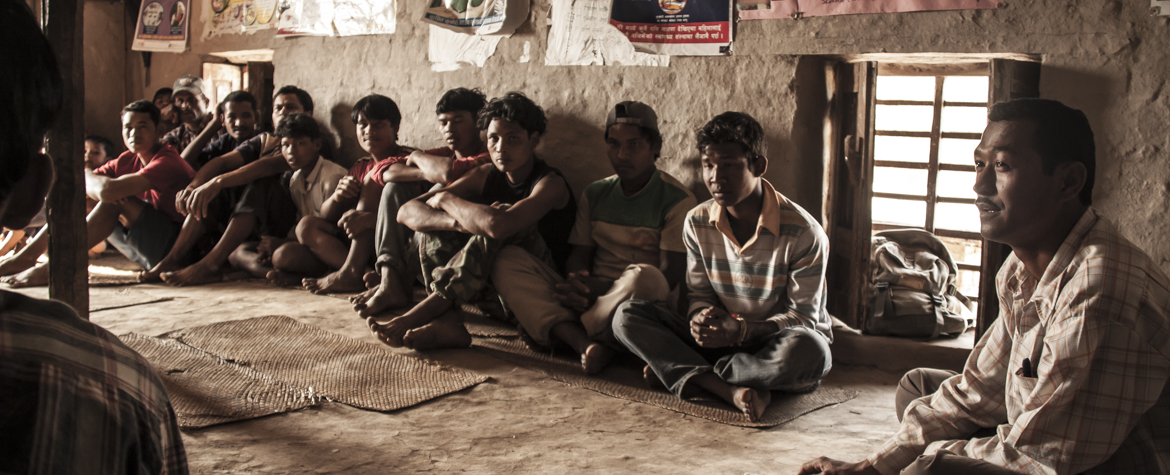
Trainings under sumarga
program
|
The training and action research unit
provides capacity building training to its research
team and also NGOs working in health and community development
sectors.
Action programs are undertaken to experiment
the efficacy of selected SRH related models in a community
setting.
Types of Training :
• Focused Ethnographic Study (FES)
and use of FES software packages such as ANTHROPAC,
ATLAS-TI, KRAKPLOT, etc.
• PRA, RRA, Narrative methods
• Size Estimation
• Social Mapping and Eco Mapping
Action Programs
Public Education and Advocacy against
Unsafe Abortions : sumarga program (through networks
of 47 NGOs)
Ethnographic Research on High Risk Population
Injecting Drug Users
|
Since 2001, CREHPA has been conducting
a series of focussed ethnographic research including
mapping and size estimation of “hard to reach”
population such as female sex workers, injecting drug
users, clients of female sex workers and Men having
sex with Men (MSM). These research studies were sponsored
by the Family Health International (FHI).
Network of Injecting Drug Users

Research on Trafficking
Cross-border trafficking of women and
girls into forced prostitution and other slavery-like
situations are one of the world’s fastest growing
crimes and most significant human rights violations.
From Nepal, thousands of young women and girls have
been trafficked across the border and sold to brothels
in India.
Ethnographic study on ‘Destination
Side’ of the Trafficking of Nepalese Girls to
India is being conducted by CREHPA under the funding
support of Tdh in two cities of India - Mumbai and Kolkata.
The study is aimed at documenting the
situation of the Nepali women and girls in Indian brothels
environments and to investigate the attitudes, wishes
of Nepali women and girls in the Indian brothels. Furthermore
the study also investigates the attitudes of the clients
of Nepali sex workers and the brothel keepers.
Sexual and Reproductive Health of Adolescent
In Nepal, adolescent population is approximately
5.4 million (23.6%) (2001 Census). According to the
Central Bureau of Statistics (CBS), the adolescent population
is estimated to reach 6 million by the year 2011 and
to almost 7 million in 2021.
Addressing the needs of adolescents is
a challenge that goes beyond the role and responsibilities
of health sector alone. The legal framework, government
policies, socio-cultural norms and practices and opportunities
for education and, employment and recreation are some
of the factors that are key to adolescent health and
development.
The WHO in collaboration with Ministry
of Health intends to prepare a health sector strategy
on adolescent health and development for Nepal. In regard
to this, the country profile on Adolescent Health and
Development and a concept paper on health sector strategy
for AHD is being prepared by CREHPA
Research and Advocacy for Reproductive
Health and Rights
• Public Education
and Advocacy Program against Unsafe Abortion
Since 1999, CREHPA has networked with
47 district based NGOs of Nepal for implementing its
Public Education and Advocacy Program (PEAP) which was
aimed at preventing unsafe abortion practices,creating
an enabling environment for the legalisation of abortion
and saving women's lives.
• “sumarga” - Power
of Informed Reproductive Decisions
Since 2003, CREHPA has initiated a new
program called "sumarga" (Right Path) in partnership
with its districts based NGOs to create enabling environment
for women to make informed reproductive decisions and
options.
sumarga Program
Public Education and Advocacy to Enable
Informed Fertility Decisions by Women in Nepal
sumarga Program Coverage
47 District based NGOs in 43 Districts
Identified and Empowered under sumarga program
• Operation Research Project implemented
in Kaski District
• Private Paramedics and Chemists (PPC) networking
with CAC Centers in 6 Districts in collaboration with
6 local district partner NGOs
• Intensive program in 10 districts in collaboration
with 10 district based NGOs
Research & Advocacy to Influence
Policy
Contributed significantly in influencing
Policy towards Legalisation of Abortion
Major Achievement
• Public Education & Advocacy
against Unsafe Abortions: sumarga program implemented
in 43 districts
• 47 District based NGOs Identified and Empowered
under sumarga program
• Production of Sachetana, an Educational Tele-film
on Abortion
• Inclusion of PEAP Related Strategies in Government's
Long Term Plan for Safe Motherhood
• DHO/MOH Demand Orientation Training for TBAs
against Unsafe Abortion
• Acceptance and Ownership of the IEC Materials
(posters) on Abortion by MOH
• Member of the Abortion Task Force (ATF) Formed
by FHD/MOH to Plan and Implement the Steps to Move from
Legalisation to Action
Funding Organisations of CREHPA in last
5 years (2000-2004)
• Adventist Development and Relief
Agency (ADRA), Nepal
• Center for Development and Population Activities/Nepal
(CEDPA)
• Department for International Development (DFID)
• Family Health International (FHI) /Nepal
• International Labour Organization (ILO)
• Netherlands Interdisciplinary Demographic Institute
(NIDI)
• Ipas
• The Population Council
• Terre des hommes (Tdh)
• The Ford Foundation
• Program for Appropriate Technology in Health
(PATH)
• Planned Parenthood Federation of America-International
(PPFA-I)
• World Health Organization (WHO)
Network & Alliances
Universities :
•Department of Social Statistics, Southampton
University, Southampton, UK
•Center for Population Studies, London School
of Hygiene and Tropical Medicine (LSHTM), University
of London, UK
•The Key Center for Women's Health in Society,
Department of Public health, School of Public Health,
The University of Melbourne, Melbourne, Australia.
•Institute for Population and Social Research
(IPSR), Bangkok
HMG/National Bodies :
•Ministry of Health (MOH)
•Ministry of Population & Environment (MOPE)
•National Health Research Council (NHRC)
Research Institutions :
• Center for Operations Research and Training
(CORT), Baroda, India- and CORT Dhaka, Bangladesh
• Netherlands Interdisciplinary Demographic Institute
(NIDI)
• SEARCH Nepal
• Forum for Women Law and Development (FWLD),
Nepal
International :
• World Health Organization (WHO)
NGOs :
• 47 district based partner NGOs covering 43 districts
of the country |